Why Startup Business Models Matter More Than Ever in 2025
Every successful startup begins with one simple but powerful foundation — a startup business model. It’s more than just a fancy document for investors; it’s the blueprint that explains how your startup creates value, delivers it to customers, and turns it into revenue. Without the right model, even the most innovative idea risks running out of cash or failing to scale.
In 2025, the startup ecosystem is more competitive than ever. Investors no longer just look for great ideas — they want to see clear types of business models that prove your startup can grow sustainably. Whether it’s a subscription model, marketplace model, or freemium approach, the business model you choose can determine whether you attract funding or struggle to survive.
Throughout this article, we’ll break down the most common business model startups are using today, show you a real business model startup example, and share expert tips on choosing the right one for your venture. If you’re a founder looking to build not just a product but a long-lasting company, understanding business models is your first big step.
What is a Startup Business Model?
A startup business model is the blueprint of how a startup creates value, delivers it to customers, and captures revenue in return. Unlike traditional companies that often rely on fixed and proven models, startups usually experiment with innovative and flexible approaches. The right business model doesn’t just describe how you make money—it explains the entire logic of your business, from identifying your target market to delivering your product or service efficiently.
For startups, having a clear business model is crucial because it:
- Shows investors how the company plans to grow and sustain itself.
- Helps founders make better decisions about pricing, operations, and customer acquisition.
- Creates a roadmap that guides the team as the business scales.
In short, your business model is the foundation of your startup. Without it, even a great idea may struggle to attract funding or survive in the market.
Types of Startup Business Models
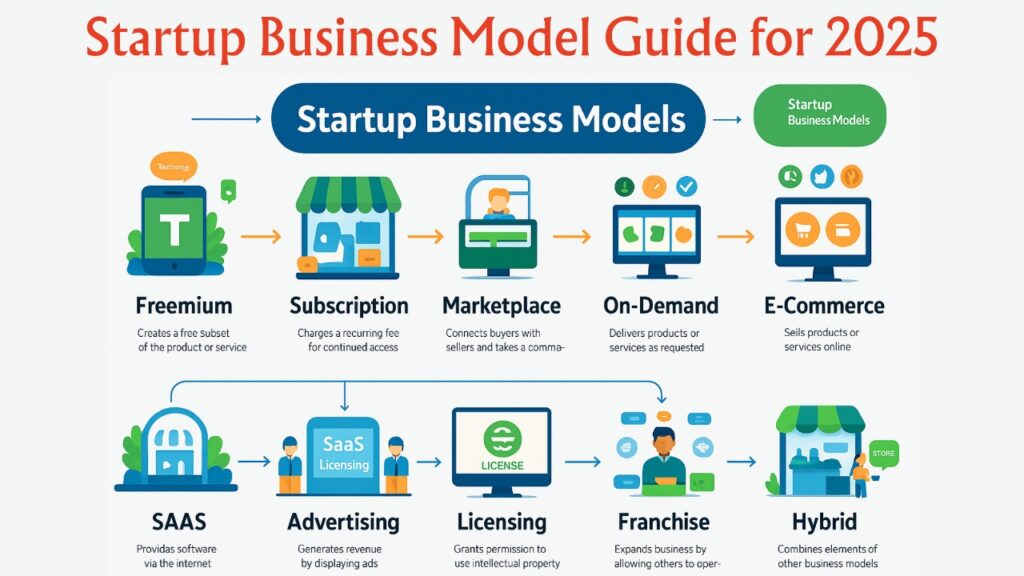
When it comes to building a startup business model, there’s no “one-size-fits-all.” The right choice depends on your product, target audience, industry, and scalability potential. Let’s explore the most popular types of business models for startups, along with examples to make them easier to understand.
1. Freemium Model
Startups offer a free version of their product with limited features, while advanced features are available in the paid version.
- Why it works: Low entry barrier attracts users quickly.
Example: Spotify lets users listen for free with ads, but its premium subscription removes ads and adds offline access.
2. Subscription Model
Customers pay a recurring fee (monthly, quarterly, yearly) to access products or services.
- Why it works: Provides predictable recurring revenue and customer loyalty
Example: Netflix’s success is built on this model, where users pay monthly for streaming content.
2. Subscription Model
Customers pay a recurring fee (monthly, quarterly, yearly) to access products or services.
- Why it works: Provides predictable recurring revenue and customer loyalty
Example: Netflix’s success is built on this model, where users pay monthly for streaming content.
3. Marketplace Model
The startup connects buyers and sellers, taking a commission on transactions.
- Why it works: Scalable with minimal inventory risks.
Example: Airbnb doesn’t own properties but earns by facilitating bookings between hosts and travelers.
4. On-Demand Model
Customers get instant access to products/services through technology platforms.
- Why it works: Offers convenience and speed, making it attractive to modern consumers.
Example: Uber connects riders with drivers in real time.
5. E-commerce Model
Startups sell products directly through digital platforms instead of physical stores.
- Why it works: Global reach, lower costs, and faster growth potential.
Example: Amazon started as an online bookstore and grew into the world’s largest e-commerce platform.
6. SaaS (Software as a Service) Model
Software is hosted in the cloud and accessed via subscription.
- Why it works: Low upfront costs for users, high scalability for startups.
Example: Slack charges businesses a subscription for seamless team collaboration tools.
7. Advertising Model
Free products/services are provided, and revenue is earned through advertisements.
- Why it works: Works best when you have a large user base.
Example: Facebook is free to use, but it generates billions in ad revenue.
8. Licensing Model
Startups develop intellectual property (IP) and license it to other companies.
- Why it works: Great for tech or biotech startups with patents and innovations.
Example: ARM Holdings licenses chip designs to companies like Apple and Qualcomm.
9. Franchise Model
Expanding a business by letting other entrepreneurs operate under the brand’s name.
- Why it works: Helps scale faster with shared investment.
Example: McDonald’s scaled globally by allowing franchise owners to run outlets under its brand.
10. Hybrid Models
Many startups combine two or more types of business models to maximize revenue.
Example: LinkedIn offers a freemium model for users, subscription plans for recruiters, and advertising revenue—a hybrid that works at scale.
Choosing the right business model startup example is often about testing and adapting. What works for one startup may not work for another. The goal is to find a model that aligns with your product, customer needs, and growth vision.
How to Choose the Best Business Model for Your Startup
Picking the right startup business model can make or break your venture. While many founders get inspired by successful companies, blindly copying a model rarely works. Instead, follow these steps to find the model that fits your startup, market, and growth vision:
Step 1: Understand Your Target Audience
- Identify who your customers are, what problems they face, and how much they’re willing to pay.
Example: If your target users prefer free access but may pay for premium features later, a freemium model might work best.
Step 2: Analyze Revenue Streams
- Determine how your startup will earn money: subscriptions, transactions, ads, licensing, or a mix.
Make sure the revenue potential matches your startup’s growth ambitions.
Step 3: Assess Scalability
- Ask yourself: Can this model grow as my user base grows without proportionally increasing costs?
Scalable models like marketplaces or SaaS often attract investors more easily.
Step 4: Factor in Industry & Competition
- Some models are more effective in certain industries. For example:
- Advertising-driven models thrive on high traffic platforms.
- Licensing suits tech, biotech, or IP-heavy startups.
- Advertising-driven models thrive on high traffic platforms.
Study competitors’ models but focus on differentiation rather than imitation.
Step 5: Consider Operational Complexity
- Some business models require more logistics, inventory, or legal compliance.
Example: E-commerce startups need inventory management, whereas SaaS or digital platforms have fewer physical overheads.
Step 6: Test and Validate
- Launch a minimal version of your model (MVP) to see if customers respond positively.
Collect feedback, measure revenue potential, and pivot if needed.
Step 7: Align With Investor Expectations
- Investors prefer models that are predictable, scalable, and monetizable.
A clear business model shows you’ve thought through growth, revenue, and sustainability.
By following these steps, you’ll not only pick a suitable business model startup example but also create a foundation that attracts funding, supports growth, and minimizes costly mistakes.
Business Model Startup Examples
Understanding theory is one thing, but seeing business model startups in action makes it crystal clear. Here are a few real-world examples of startups and the models that powered their success:
1. Netflix – Subscription Model
- Netflix charges users a recurring monthly fee for streaming content.
- Why it works: Predictable revenue, customer loyalty, and continuous content investment.
- Lesson: A subscription-based model can scale globally if your product delivers consistent value.
2. Spotify – Freemium Model
- Users can listen for free with ads or upgrade to premium for ad-free listening and offline access.
- Why it works: Attracts a massive user base quickly while generating revenue from paying subscribers.
- Lesson: Freemium models lower barriers to adoption but can convert free users into paying customers over time.
3. Uber – On-Demand & Marketplace Model
- Connects riders with drivers, taking a commission on every ride.
- Why it works: Low operational costs, scalable, and meets a real-time customer need.
- Lesson: Combining marketplace efficiency with on-demand convenience can disrupt traditional industries.
4. Dropbox – Freemium & SaaS Model
- Offers a free cloud storage option with limited space, charging for premium plans.
- Why it works: Builds a large user base, encourages upgrades, and provides recurring SaaS revenue.
- Lesson: Hybrid models can maximize adoption and revenue simultaneously.
5. Amazon – E-commerce & Hybrid Model
- Started as an online bookstore, expanded into multiple categories, and added subscription services like Prime.
- Why it works: Diversified revenue streams, massive scale, and brand loyalty.
- Lesson: Hybrid models allow startups to combine multiple business strategies for maximum growth potential.
These examples show that the right business model is more than just a way to make money—it’s a strategic tool to attract customers, investors, and scale effectively.
Common Mistakes Startups Make with Business Models
Even the most promising startups can stumble if their startup business model isn’t carefully thought out. Here are the most common mistakes founders make—and how to avoid them:
1. Copying Big Companies Blindly
- Mistake: Trying to replicate models of successful giants without adapting to your market.
- Solution: Learn from them, but test your model for your unique customers and resources.
2. Ignoring Revenue Streams
- Mistake: Focusing only on product development while overlooking how money will actually come in.
- Solution: Clearly define your revenue streams early, whether it’s subscriptions, freemium, marketplace fees, or ads.
3. Not Testing or Validating the Model
- Mistake: Launching without testing if your model works in the real world.
- Solution: Use an MVP to validate assumptions, gather feedback, and iterate.
4. Underestimating Operational Complexity
- Mistake: Choosing a model that’s hard to manage logistically or financially.
- Solution: Consider your team, resources, and scalability when selecting a model.
5. Sticking Rigidly to One Model
- Mistake: Refusing to pivot even when market signals show it’s not working.
- Solution: Stay flexible—successful startups often evolve their business models as they grow.
By avoiding these mistakes, founders can save time, money, and frustration while building a scalable and investor-ready startup business model.
How to Validate Your Startup Business Model Before Scaling
Validating your startup business model is crucial before investing heavily in growth. A model that works on paper may fail in the real world if customer behavior, pricing, or market fit isn’t tested. Here’s how founders can validate their business model effectively:
1. Launch a Minimal Viable Product (MVP)
- Start small with the core features that solve the primary problem.
- Collect user feedback and see if customers are willing to pay for the value you provide.
2. Conduct Market Research
- Understand your target audience, competitors, and industry trends.
- Identify gaps in the market where your business model can offer unique value.
3. Test Revenue Streams
- Experiment with pricing strategies: subscriptions, freemium upgrades, or pay-per-use.
- Measure which model generates the most traction and revenue potential.
4. Gather Customer Feedback
- Conduct surveys, interviews, or usability tests to understand customer needs and preferences.
- Adjust your model based on what real users value most.
5. Use Pilot Programs or Soft Launches
- Launch your product or service in a limited market to test your model without major risk.
- Track engagement, retention, and profitability metrics.
6. Analyze Metrics and Iterate
- Focus on key performance indicators like customer acquisition cost (CAC), lifetime value (LTV), and churn rate.
- Continuously refine your model to improve revenue, efficiency, and customer satisfaction.
By carefully validating your business model, founders increase their chances of attracting investors, achieving sustainable growth, and building a long-lasting startup.
How Innomax Startup Advisory Helps Startups Build Strong Business Models
Building a successful startup business model is rarely a solo journey. Many founders struggle with choosing the right model, validating assumptions, and ensuring it aligns with investor expectations. That’s where Innomax Startup Advisory comes in.
Here’s how we help startups succeed:
- Expert Mentorship: Our team guides founders through selecting and refining the most suitable business model for their startup.
- Funding Support: We advise on how your business model impacts investor decisions, helping you attract the right startup investors.
- Incubation & Acceleration: From ideation to scaling, we provide structured programs that help startups test, validate, and implement their business model effectively.
- Strategic Consulting: We analyze market trends, revenue streams, and operational strategies to ensure your model is scalable and sustainable.
With Innomax, founders don’t just build a product—they create a business model that works, attracts investors, and sets the foundation for long-term growth.
Conclusion
A strong startup business model is the foundation of growth, scalability, and investor confidence. Understanding types of business models and learning from business model startup examples helps founders make smart choices.
Validating your model through testing and feedback ensures long-term success. Innomax Startup Advisory helps startups design, refine, and scale their business models to attract investors and drive growth.
FAQs
1. What is a startup business model?
A startup business model explains how your startup creates, delivers, and captures value. It shows both revenue streams and growth potential.
2. Why are business models important for startups?
A strong business model helps founders attract investors, plan growth, and scale sustainably while avoiding common pitfalls.
3. What are the common types of business models?
Common types include subscription, freemium, marketplace, SaaS, e-commerce, advertising, and hybrid models for startups.
4. Can you give a business model startup example?
Yes! Netflix (subscription), Spotify (freemium), Uber (marketplace), and Dropbox (SaaS) are real-world examples of successful models.
5. How do I choose the best business model for my startup?
Consider your target audience, revenue streams, scalability, and industry. Test your model before fully launching.
6. Can a startup change its business model later?
Absolutely! Many startups pivot their business models to adapt to market needs or growth opportunities.
7. How does the business model affect funding?
Investors look for scalable, monetizable models. A clear business model increases chances of attracting startup investors.
8. What are hybrid business models in startups?
Hybrid models combine two or more approaches, like freemium + subscription + advertising, to maximize growth and revenue.
9. How can Innomax help with my startup business model?
Innomax provides mentorship, funding support, and strategic consulting to design, validate, and scale effective startup business models.
10. Why do some startups fail despite a great product?
Often, failure happens due to a weak or untested business model. Even the best products need a sustainable plan to succeed.